Model OAS: From the Classroom to International Negotiation
We are Juliana Abeid and Sailor Whatley, sophomores at Tulane University studying Political Science and International Relations and Philosophy, and Sociology and Latin American Studies on the pre-medical track, respectively. Despite our different academic paths, we were both drawn to Model OAS to immerse ourselves in diplomacy and to understand how international institutions shape the Western Hemisphere. Model OAS is a simulation of the Organization of American States in which students from different colleges across the Americas represent member countries and debate regional issues in a formal diplomatic setting.
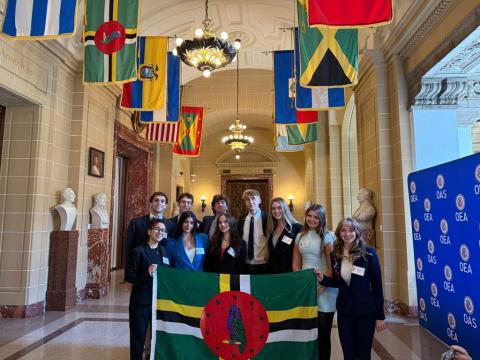
The course was led by Professor Ezra Remer, Executive Director of the Dominica Coffee Revitalization Initiative, and Professor Shane Hough, a retiring Foreign Service Officer. Professor Remer’s work with the Commonwealth of Dominica made it especially meaningful to represent one of the smallest member states in the Organization of American States, and it was an honor to learn about its culture and political history from such an informed lens. Professor Hough emphasized the practical side of diplomacy, focusing on the relevance of pragmatism and multilateral institutions.
Each class began with trivia, which served as a playful entry point into analyzing each OAS member state in detail. We typically focused on one to two countries per class, examining their history, economic conditions, and contemporary political leanings. The latter portion of the class shifted toward the institutional and applied side, including discussions on the formation and structure of the OAS. Our class was especially struck that OAS decisions are non-binding and participation is voluntary, yet countries still engage for the sake of diplomacy and regional cooperation.
As the semester progressed, we were paired up and assigned committees based on our interests and strengths: General, First (Human Rights and Democracy Promotion), Second(Hemispheric Security), Third (Integral Development), and a Special Committee on Haiti. Within these committees, we drafted Policy Draft Resolutions (PDRs), which are formal proposals addressing hemispheric issues from your country’s perspective. This required us to think strategically about solutions aligned with Dominica’s interests and capacities, moving us beyond analysis and into policymaking.
In the weeks leading up to the conference, the class became more immersive as we transitioned into role-play, representing member states and practicing OAS procedure while defending our resolutions. By the time we arrived in D.C. for the Model OAS conference, we were familiar with both debate structure and Dominica’s priorities.
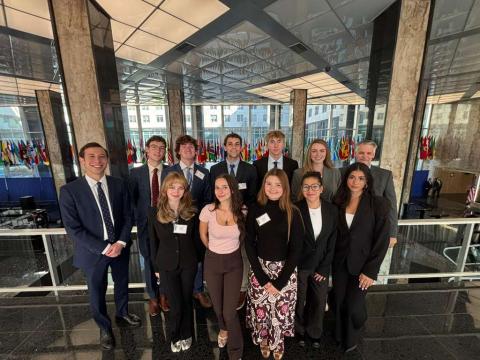
On Wednesday, during the conference, we visited the U.S. Department of State, one of the most memorable parts of the experience, marking the first time a Tulane Model OAS class had visited the Department. We met with professionals in the Office of Caribbean Affairs, who shared what their work looks like and how they entered foreign service. Hearing these perspectives was especially valuable given the range of academic backgrounds in our class.
Afterward, we traveled to Trinity Washington University by metro, and navigating D.C. was a special experience for those of us interested in working there. Once we arrived, we debated our PDRs alongside students from across the hemisphere, and we were surprised to see how differently they approached the same issues. That afternoon, the General Committee was given a crisis scenario on the humanitarian crisis in Cuba, shifting the pace of debate and requiring real-time collaboration.
That evening, we had dinner in Dupont Circle, which gave us a chance to unwind and reflect on the day before continuing the conference.
Something that stood out was how much diplomacy depends on persistence rather than immediate success. Much of the work involved long hours of negotiation and amendment-making, and not every amendment or proposal passed, which could be frustrating when significant time had been invested. Juliana was part of the General Committee working on a resolution titled Actionable Approaches for Safeguarding the Individual Sovereignty of Western Hemisphere Countries, while Sailor worked in the Third Committee on a PDR titled Promotion of Sustainable and Equitable Land-Use Practices to Address Gentrification in the Americas. Although the proposals were written from the perspective of a small island nation, they gained support from larger countries by emphasizing flexibility and mutual benefit, allowing them to be adapted without placing undue burden on other states. Ultimately, each of Tulane’s committee proposals was passed, making the outcome especially rewarding.
Through the Model OAS class and conference, we gained a stronger ability to engage in high-pressure conversations where clarity and versatility matter, while also recognizing that there is not always a “perfect” answer in diplomacy. Guided by the mentorship of Professor Shane Hough, Professor Ezra Remer, and the support of the Stone Center for Latin American Studies, we learned how global decisions shape everyday life and the importance of staying informed and engaged. We leave not only with insight, but with friendships from across the hemisphere and an appreciation for learning alongside curious peers and educators.