
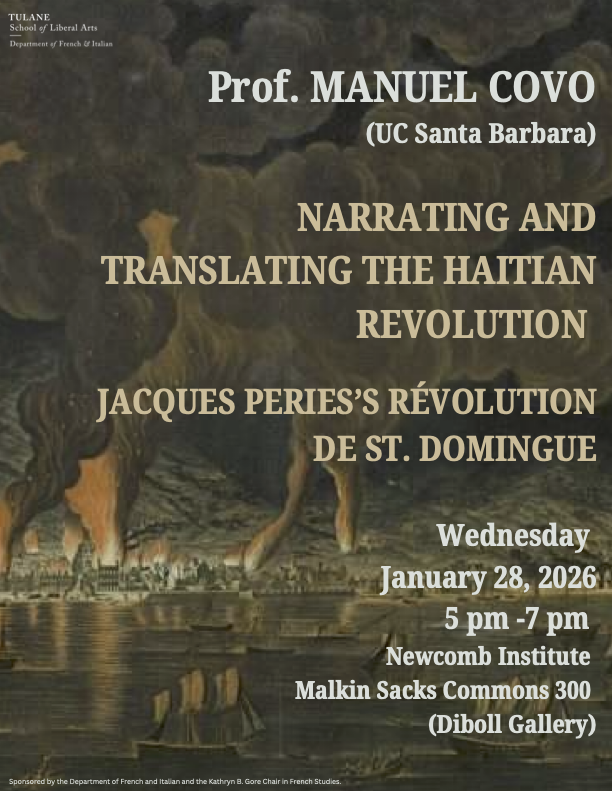
The Haitian Revolution was a moment of radical transformation, marked by the abolition of slavery, achieved through the actions of the enslaved themselves, and culminating in the creation of the first independent Black state in the Americas. Long treated as marginal within grand narratives of the Age of Atlantic Revolutions, this profoundly radical event has, over the past thirty years, been largely “unsilenced” by historians, thanks in part to the recovery and close reading of previously neglected sources. This lecture examines the major historiographical debates on the Haitian Revolution through the lens of a hitherto unpublished source: Révolution de St. Domingue, written in 1804 by an obscure French bureaucrat named Jacques Peries. Using this case study, the talk reflects on what it means to read a source both along and against the grain in order to interrogate power relations, violence, racialization, and gender in the context of the Haitian Revolution, an event long dominated by the narratives of white colonists. Finally, the lecture suggests that the work of translating the manuscript from French into English for a critical edition forms part of the critical deconstruction of the source, and thus of the very practice of historical interpretation.
