
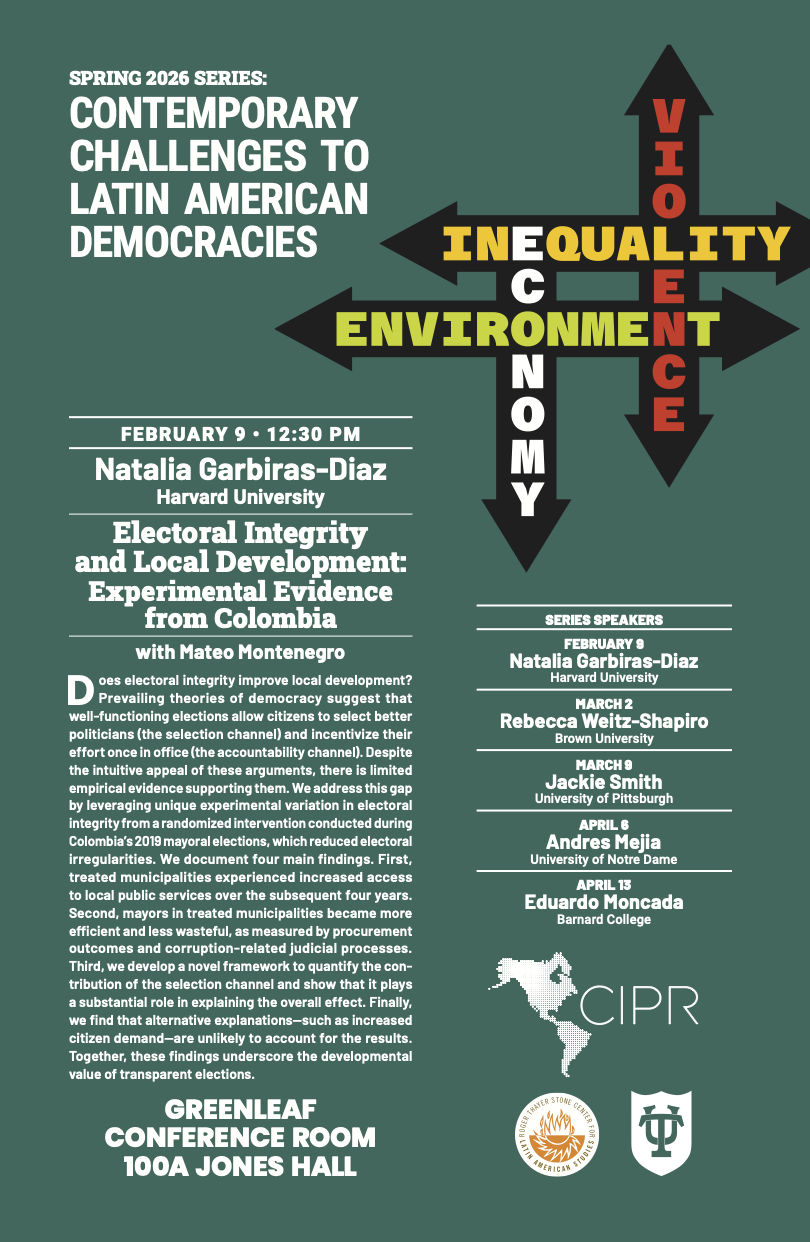
Natalia Garbiras-Diaz (Harvard University)
Does electoral integrity improve local development? Prevailing theories of democracy suggest that well-functioning elections allow citizens to select better politicians (the selection channel) and incentivize their effort once in office (the accountability channel). Despite the intuitive appeal of these arguments, there is limited empirical evidence supporting them. We address this gap by leveraging unique experimental variation in electoral integrity from a randomized intervention conducted during Colombia’s 2019 mayoral elections, which reduced electoral irregularities. We document four main findings. First, treated municipalities experienced increased access to local public services over the subsequent four years. Second, mayors in treated municipalities became more efficient and less wasteful, as measured by procurement outcomes and corruption-related judicial processes. Third, we develop a novel framework to quantify the contribution of the selection channel and show that it plays a substantial role in explaining the overall effect. Finally, we find that alternative explanations—such as increased citizen demand—are unlikely to account for the results. Together, these findings underscore the developmental value of transparent elections.
Upcoming events in the series:
March 2: Rebecca Weitz-Shapiro (Brown)
March 9: Jackie Smith (University of Pittsburgh)
April 6: Andres Mejia (University of Notre Dame)
April 13: Eduardo Moncada (Barnard College)